- One Stop for all Business Utilities
- (0800) 999-1160
- quotes@betaenergydirect.com

Out of Contract?

The Hidden Charge Set to Double Your Electricity Costs This Year
August 3, 2026
Why More UK Businesses Are Switching Energy Suppliers
August 12, 2026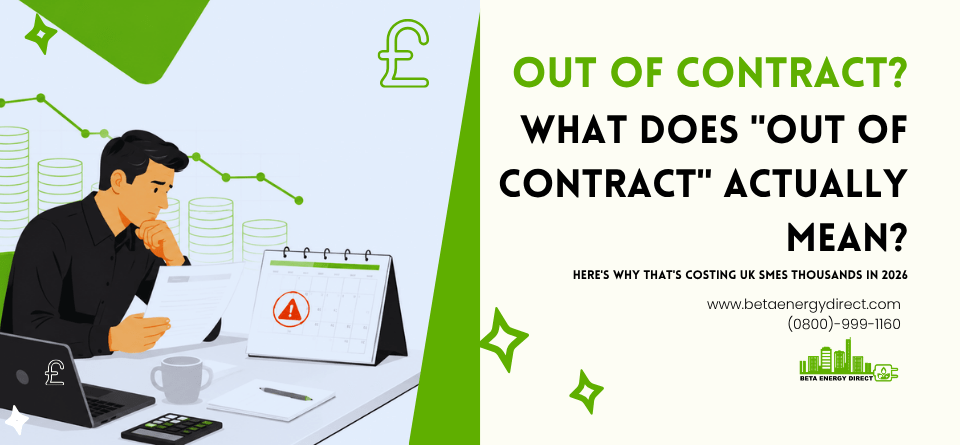
Out of Contract? Here’s Why That’s Costing UK SMEs Thousands in 2026 | A Guide by Beta Energy Direct
If your business energy contract quietly expired and nobody flagged it, you are not alone — and you are almost certainly paying far more than you should be. In 2026, businesses sitting on out-of-contract or deemed rates are typically paying 30% to 70% more per unit than a business on a properly negotiated fixed deal, with average out-of-contract electricity rates now running at around 35–38p per kWh, compared to 22–30p per kWh on a fixed contract.
For a typical small business using 40,000 kWh a year, that gap can mean paying an extra £3,200 to £4,000 annually, purely for doing nothing. For a micro-business, it is still commonly £1,200 to £1,500 a year wasted. This article explains exactly what “out of contract” means, why it happens so easily, how much it is really costing UK SMEs in 2026, and the fastest way to fix it.
What Does “Out of Contract” Actually Mean?
When your fixed-term business energy contract ends and you have not signed a new deal or switched supplier, you do not simply stop being supplied. Instead, your existing supplier automatically rolls you onto their out-of-contract rate (sometimes called a deemed rate) — their own default, unilaterally set pricing, applied without any negotiation on your part.
Out-of-Contract vs Deemed Rates: What’s the Difference?
The two terms are often used interchangeably, but there is a technical distinction:
- Out-of-contract rates apply when your fixed term ends and you remain with the same supplier without signing a new agreement.
- Deemed rates apply when a business takes supply without ever having agreed a contract at all — most commonly after moving into a new premises where the previous occupier’s contract has ended, or where a supplier has been appointed under an “supplier of last resort” arrangement.
In practice, both situations lead to the same outcome: you are paying the supplier’s highest, least competitive rate, without ever having agreed to it.
Why Out-of-Contract Rates Are So Expensive
This is not a penalty charge, and it is not a mistake on the supplier’s part — it is simply how the market is designed to work.
Suppliers have little commercial incentive to offer competitive pricing to businesses that are not actively comparing the market. A business that has not shopped around in months, or years, is far less price-sensitive from the supplier’s perspective, so these default tariffs are deliberately set at the top of the pricing range. There is no regulatory cap limiting how high they can go, unlike the household price cap that protects domestic customers.
How Much Higher Are Out-of-Contract Rates in 2026?
Current published data across the UK business energy market in 2026 shows a stark gap:
| Contract Type | Typical Electricity Rate | Typical Standing Charge |
|---|---|---|
| Fixed-rate deal (actively managed) | 22–30p/kWh | 35p–£1.50/day |
| Out-of-contract / deemed rate | 32–47.5p/kWh | £2–£3.50/day |
Some individual suppliers are charging even more. Published 2026 rate schedules show out-of-contract electricity rates from major suppliers ranging as high as 44–47p/kWh, with standing charges commonly 2 to 4 times higher than a fixed-rate equivalent. Gas tells the same story, with out-of-contract gas rates typically sitting at 11–14p/kWh, against 7.5–9p/kWh on a fixed deal.
A Real-World Cost Comparison
Here is what that difference actually looks like on an annual bill:
- Micro-business (15,000 kWh/year): Fixed contract costs roughly £3,300–£4,500 annually. On out-of-contract rates, the same usage costs £4,800–£6,000 — an extra £1,200 to £1,500 a year.
- Small business (40,000 kWh/year): Fixed contract costs roughly £8,800–£12,000 annually. On out-of-contract rates, expect £12,800–£16,000 — an extra £3,200 to £4,000 a year.
- Medium business (100,000+ kWh/year): The gap can easily exceed £8,000–£10,000 annually.
These are not one-off figures — they repeat every single billing cycle for as long as the business remains out of contract, which is exactly why the total cost adds up so quickly over a year.
Why Businesses End Up Out of Contract So Easily
Most business owners do not deliberately let their energy contract lapse. It happens for entirely understandable reasons:
1. Long Contract Terms Make Renewal Dates Easy to Forget
A two- or three-year fixed deal feels like a “set and forget” decision at the time of signing. By the time it expires, the renewal date has often slipped well down the priority list, especially for businesses without a dedicated facilities or procurement function.
2. Suppliers Are Not Required to Proactively Warn You in a Meaningful Way
While suppliers typically send a renewal notice before a contract ends, these notices are easy to miss among routine correspondence, and there is no requirement for suppliers to make the financial consequences of inaction obvious.
3. Change of Tenancy or Business Premises
If your business moves into new premises, or takes over a site from a previous occupier, you may be placed on deemed rates automatically from day one, simply because no new contract has been agreed yet.
4. Uncertainty About Which Supplier to Choose
Faced with dozens of suppliers and tariff structures, some business owners delay renewing simply because comparing the market feels time-consuming — not realising that delay itself is the most expensive option of all.
How to Check If Your Business Is Out of Contract Right Now
You can usually confirm your status in a few minutes:
Step 1: Find Your Contract End Date
Check your most recent business energy invoice, your supplier’s online portal, or your original contract documentation for the agreed end date.
Step 2: Look for Warning Words on Your Bill
Terms like “deemed,” “out of contract,” “variable,” or “default” appearing on your bill are a strong signal that you are already paying inflated rates.
Step 3: Compare Your Current Unit Rate Against the Market
If your electricity unit rate is above roughly 30p/kWh, or your gas rate is above roughly 10p/kWh, there is a good chance you are on an out-of-contract tariff rather than a competitively negotiated one.
Step 4: Check How Your Standing Charge Compares
A standing charge above roughly £1.50–£2 per day for electricity is another strong indicator, since out-of-contract standing charges typically run at two to four times the fixed-rate level.
The Good News: You Can Exit an Out-of-Contract Rate Quickly
Unlike a fixed-term contract, which usually carries an early termination charge if you leave before the end date, out-of-contract and deemed rates typically allow you to switch supplier with as little as 28 days’ notice, and without penalty. This means that once you realise you are on one, there is genuinely nothing stopping you from moving to a competitive fixed deal almost immediately.
Why Speed Matters
Every additional week spent on an out-of-contract rate is a week paid at the most expensive tariff available to your business. There is no advantage to waiting, and no scenario in which staying on a default rate works out cheaper than switching, given the scale of the gap between deemed and fixed pricing in 2026.
What UK SMEs Should Do Next
1. Get an Independent Market Comparison
Because out-of-contract rates vary so significantly between suppliers — from roughly 35p/kWh up to nearly 48p/kWh on some published schedules — the only way to know exactly how much you are overpaying is to compare live quotes against your actual usage.
2. Fix Your Rate Before Prices Move Again
With wholesale forwards broadly flat but not guaranteed to stay that way, and 24–36 month fixed contracts currently pricing close to, or even below, shorter-term deals, locking in a rate now protects your business from further exposure to default pricing.
3. Set a Renewal Reminder for Next Time
Once you are back on a fixed contract, note the end date somewhere visible, or ask your broker to flag your renewal window in advance, so you are never caught out again.
4. Review Gas and Electricity Separately
Suppliers rarely offer their best rate across both fuels simultaneously, so comparing business gas and business electricity independently, rather than accepting a bundled deal, usually produces a better combined price.
How Beta Energy Direct Helps SMEs Escape Out-of-Contract Rates
At Beta Energy Direct, based in Manchester and working with SMEs and corporates across the UK, helping businesses escape expensive out-of-contract and deemed rates is one of the most common — and most impactful — pieces of work we do. Because the gap between default pricing and a competitive fixed deal is so large in 2026, this is often the fastest win available to a business looking to cut costs.
Our approach gives you:
- Effortless comparison of live tariffs across the whole business energy market, not just your existing supplier’s renewal offer
- Dedicated, qualified staff who can quickly confirm whether you are currently out of contract and what it is costing you
- Best prices guaranteed on the deals we recommend
- Less paperwork and quicker approvals, so switching away from an expensive default rate does not become another delayed task
If you are unsure whether your business is currently on an out-of-contract rate, get a free business energy quote and we will check your current rate against the live market at no cost.
Don’t Stop at Energy: Review Your Wider Utility Contracts Too
Out-of-contract pricing is not unique to energy. Business owners who discover they have been overpaying on electricity often find similar gaps in their business water supply, broadband and telecom contracts, or business finance arrangements, simply because renewal dates across multiple suppliers are easy to lose track of. A periodic review across your full utilities stack is one of the simplest ways to protect your margins.
Frequently Asked Questions
What happens if my business energy contract expires and I don’t renew?
Your supplier automatically moves you onto their out-of-contract or deemed rate — their own default pricing, which is almost always significantly higher than a competitively negotiated fixed deal. There is no grace period and no automatic protection against this.
How much more expensive are out-of-contract rates in 2026?
On average, out-of-contract electricity rates run 30% to 70% higher than fixed-rate deals, with typical out-of-contract rates around 35–38p/kWh compared to 22–30p/kWh on a fixed contract. Some suppliers’ published schedules show out-of-contract rates as high as 44–47p/kWh.
Can I switch away from an out-of-contract rate without penalty?
Yes. Unlike a fixed-term contract, out-of-contract and deemed rates typically do not carry early termination charges, and you can usually switch supplier with around 28 days’ notice.
How do I know if my business is currently out of contract?
Check your latest bill for terms like “deemed,” “out of contract,” or “variable” pricing, and compare your contract end date against today’s date. If your unit rate is noticeably above 30p/kWh for electricity or 10p/kWh for gas, you are very likely on a default rate.
Is there a price cap protecting businesses on out-of-contract rates?
No. The Ofgem price cap applies only to domestic customers. Business energy pricing, including out-of-contract rates, is generally contract-based and unregulated in terms of the unit price a supplier can charge.
How quickly can I fix a new rate if I am out of contract?
In most cases, you can arrange a new fixed-rate contract and begin the switch within days of comparing the market, since there is no existing fixed term to work around. Request a free quote to see how quickly your business could move onto a better rate.
Stop Paying the Market’s Most Expensive Rate
Being out of contract is one of the most common, and most costly, situations a UK SME can find itself in — and in 2026, the financial gap between default pricing and a competitive fixed deal has never been wider. The fix is simple and carries no penalty: compare the market, lock in a fair rate, and stop paying thousands more than you need to.
Call Beta Energy Direct on (0800) 999-1160 or request your free energy comparison today, and let our team check whether your business energy contract is costing you more than it should.