- One Stop for all Business Utilities
- (0800) 999-1160
- quotes@betaenergydirect.com

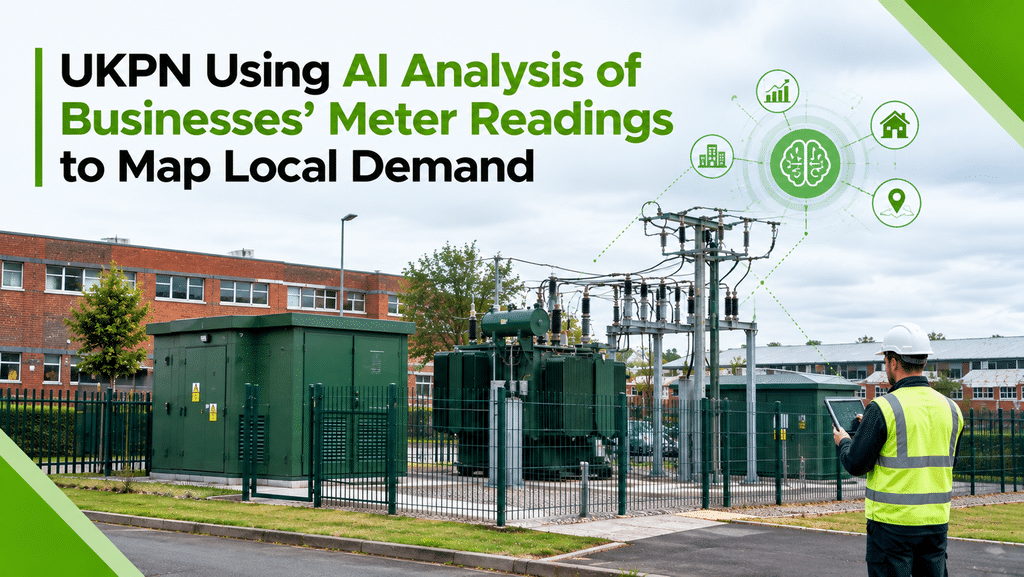
UKPN Using AI Analysis of Businesses’ Meter Readings to Map Local Demand

The Biggest Business Energy Trends Every UK Business Owner Needs to Know in 2026
September 20, 2026
No Escape From the Energy Shock for UK Business — A Long-Term Strategy Is Still Essential
September 27, 2026
UKPN’s AI Meter Analysis: What It Means for UK Businesses
UK Power Networks has started running artificial intelligence across millions of half-hourly electricity readings from its commercial and industrial customers, building a far more detailed picture of demand on the local low-voltage network than manual analysis has ever allowed. The goal, according to UKPN, is straightforward: use that granular data to shape investment decisions and speed up new customer connections across London, the South East, and the East of England.
If you run a UK SME, this might sound like a story about network engineering that has nothing to do with your business. It isn’t. Your own meter readings are part of the dataset UKPN is now analysing, and the outcome of this project could directly affect how quickly your business gets connected, how competitive your local network charges are, and how much visibility you have over your own energy data going forward. Here’s what’s actually happening, and why it’s worth understanding.
What UK Power Networks Is Actually Doing
From Manual Estimates to Granular, Data-Driven Mapping
UK Power Networks (UKPN) is the Distribution Network Operator responsible for delivering electricity to more than 8 million homes and businesses, supplying over 27% of Great Britain. Historically, understanding exactly how demand behaves across its local, low-voltage network relied heavily on estimates and periodic sampling, simply because analysing every individual half-hourly reading manually wasn’t practical at scale.
That’s changed. UKPN is now applying AI and machine learning models to millions of half-hourly meter readings from business customers, using this to build a genuinely granular, site-by-site view of demand across its low-voltage network — the local wiring that ultimately connects to individual commercial premises, rather than the high-voltage transmission backbone.
The Technology Behind It
UKPN’s approach relies on large-scale data platforms, including Databricks and Dash Enterprise, to process datasets built from smart meter readings collected as frequently as every minute at some sites. That data feeds into a low-voltage network capital planning application, giving UKPN’s electrical engineers and finance teams a high-level view of the network of substations, and helping them evaluate exactly where investment is genuinely needed, rather than relying on broad regional assumptions. UKPN has previously stated this kind of data-driven approach forms part of a wider strategy aimed at saving customers more than £400 million.
Why UKPN Is Doing This Now
UKPN operates as Great Britain’s first independent Distribution System Operator (DSO), a role launched in 2023 specifically to provide sufficient electricity capacity across its regions at the lowest possible cost, while supporting the wider transition to net zero. Mapping local demand accurately is central to that role. Without granular data, network operators risk either over-investing in areas with modest actual demand, or under-investing in areas facing genuine capacity pressure — both of which ultimately cost customers money, either through higher charges or through slower, more constrained connections.
Why This Matters to UK SMEs Specifically
Your Meter Data Is Part of the Picture
If your business operates on a half-hourly meter, which is standard for larger commercial and industrial sites, or increasingly common as smart meter adoption grows among smaller businesses, your consumption data is contributing directly to this analysis. This is part of a broader shift where business energy data is used more decisively by network operators, not just by suppliers.
Faster, Smarter Connections for New and Expanding Businesses
One of UKPN’s stated aims is accelerating customer connections. For any UK SME planning to move premises, expand capacity, install EV charging infrastructure, or add on-site generation such as solar, a more accurate understanding of local network capacity could mean faster connection approvals and fewer delays caused by network operators erring on the side of caution due to incomplete data.
Better-Targeted Network Investment Could Ease Future Charges
Distribution Use of System (DUoS) charges — the regional element of your electricity bill that funds the local network — currently vary by around 4p per kWh between the cheapest and most expensive of the UK’s 14 distribution licence areas, driven by factors like geography, demand density, and line losses. More precise demand mapping gives network operators like UKPN a stronger basis for targeting investment where it’s genuinely needed, which, over time, has the potential to keep unnecessary charges lower for businesses in accurately assessed areas, compared to relying on broader estimates that may overstate investment needs in some locations.
This Sits Within a Much Bigger Data Shift Across UK Metering
UKPN’s initiative isn’t happening in isolation. It reflects a wider industry direction, with 2026 widely described as the year UK businesses start making their meter data work for them in a much more direct way. Currently, only around 64% of non-domestic properties have smart meters installed, despite government support and exchange programmes, meaning a meaningful share of UK businesses still aren’t generating the kind of granular data this analysis depends on.
The Bigger Regulatory Picture: Market-Wide Half-Hourly Settlement
What MHHS Actually Is
Running alongside UKPN’s own initiative is a much larger industry-wide reform called Market-Wide Half-Hourly Settlement (MHHS). From December 2026, the energy industry must submit half-hourly consumption data for all metering types to Ofgem, replacing older settlement methods that relied on estimated consumption profiles rather than actual, granular usage data.
Why MHHS Matters for Your Business
MHHS is designed to reconcile the electricity actually supplied with the actual demand from customers, on a genuinely half-hourly basis, across the entire market. In practical terms, this means businesses still using traditional, non-smart meters will need to upgrade to smart or automated meter reading (AMR) infrastructure to fully benefit from, and properly comply with, the reformed settlement system.
The Combined Effect of UKPN’s AI Analysis and MHHS
Together, these two developments point in the same direction: UK business energy data is becoming more granular, more actively analysed, and more central to how both network charges and supply contracts get priced. Businesses that already operate on smart or half-hourly meters are better positioned to benefit from this shift, both through potentially more accurate network investment and through better-informed supply contract negotiations, since suppliers pricing off real consumption data, rather than estimates, generally produce fairer quotes.
What This Means for How You Manage Your Business Energy
Smart Metering Is Becoming Less Optional
If your business still relies on estimated billing or an older meter type, this is a reasonable moment to plan an upgrade, both to prepare for MHHS compliance and to make sure your business is represented accurately in exactly the kind of demand mapping UKPN is now running. Speak to your business energy supplier about your current meter type if you’re unsure.
Accurate Data Can Work in Your Favour When Comparing Suppliers
Half-hourly consumption data gives suppliers a genuine, detailed picture of when and how your business actually uses energy, which can support more accurately priced quotes, rather than pricing based on broad estimated usage bands. This is particularly relevant for businesses with distinctive consumption patterns, such as those running heavy equipment during off-peak hours.
Network Investment Doesn’t Change Your Contract Rate Overnight
It’s worth being realistic here: more accurate network investment is a longer-term structural improvement, not something that will visibly lower your next bill. The most direct, immediate way to reduce your business gas and electricity costs remains comparing the market and securing a competitively priced fixed contract, regardless of how network planning evolves in the background.
If You’re Planning an Expansion or New Connection
If your business is planning a move, an expansion, or new infrastructure like EV charging or on-site generation, ask your network operator directly about current capacity in your area. Better data on UKPN’s side should, over time, translate into more accurate answers and potentially faster approvals, particularly in previously data-sparse areas.
How Beta Energy Direct Helps SMEs Navigate a Changing Energy Data Landscape
At Beta Energy Direct, based in Manchester and working with SMEs and corporates across the UK, we track exactly these kinds of infrastructure and regulatory shifts so our clients don’t have to piece them together themselves. Whether it’s understanding how network charges are calculated in your region, preparing for MHHS, or simply making sure your business is on a competitively priced contract while the wider market evolves, our team is here to translate the detail into practical guidance.
Our approach gives you:
- Effortless comparison of live tariffs across the whole business energy market
- Dedicated, qualified staff who understand metering, network charges, and regulatory changes like MHHS
- Best prices guaranteed on the deals we recommend
- Less paperwork and quicker approvals, so staying ahead of industry changes doesn’t become another job on your plate
If you’re unsure whether your current meter type and contract are set up correctly for where the market is heading, get a free business energy quote and let our team check your setup.
Review Your Wider Utilities Setup Too
Smart, granular data isn’t unique to energy. Many SMEs reviewing their business energy contracts with us also take the opportunity to review their broadband and telecom arrangements, and business finance options, since better data and more competitive markets are trends playing out across UK business utilities more broadly, not just electricity.
Frequently Asked Questions
What is UK Power Networks doing with business meter data?
UK Power Networks is using artificial intelligence to analyse millions of half-hourly electricity readings from business customers, building a detailed picture of demand on its local, low-voltage network. This data is intended to shape investment decisions and speed up new customer connections across London, the South East, and the East of England.
Does this affect businesses outside UKPN’s coverage area?
UKPN’s own initiative applies specifically to its licence areas, but similar data-driven approaches to network planning and Market-Wide Half-Hourly Settlement reform apply across the whole of Great Britain, regardless of which of the 14 regional distribution network operators serves your business.
Will this project reduce my business energy bill?
Not directly or immediately. More accurate network investment is a longer-term structural improvement aimed at efficient capacity planning, rather than something that will visibly change your next bill. Comparing suppliers and securing a competitively priced fixed contract remains the most direct way to reduce your energy costs.
What is Market-Wide Half-Hourly Settlement (MHHS), and does it affect my business?
MHHS is an industry-wide reform requiring half-hourly consumption data to be submitted to Ofgem for all metering types from December 2026. If your business still uses a traditional, non-half-hourly meter, you may need to upgrade to a smart or automated meter to comply and to benefit fully from more accurately priced energy contracts.
Do I need a smart meter for my business in 2026?
While not yet universally mandatory for every business type, smart and half-hourly meters are increasingly central to how both network operators and suppliers price and plan for demand. Around 64% of non-domestic properties in the UK currently have smart meters installed, and that share is expected to keep rising as MHHS reform takes effect.
How can I check if my business energy setup is ready for these changes?
The most reliable way is to speak directly with your current supplier or an independent broker about your meter type and contract structure. Request a free quote from Beta Energy Direct and we’ll review your current setup as part of the comparison.
Stay Ahead as Energy Data Gets Smarter
UK Power Networks’ move to AI-driven demand mapping is a clear sign of where the UK energy sector is heading: more granular data, more precisely targeted investment, and a market that increasingly rewards businesses with accurate, half-hourly consumption data. Understanding where your business fits into that picture now puts you in a stronger position as these changes continue to roll out.
Call Beta Energy Direct on (0800) 999-1160 or request your free energy comparison today, and make sure your business energy setup is ready for a smarter, more data-driven network.