- One Stop for all Business Utilities
- (0800) 999-1160
- quotes@betaenergydirect.com

How Rising Energy Prices Are Impacting UK Businesses

Why More UK Businesses Are Switching Energy Suppliers
August 12, 2026
UK Energy Cyberattack 2026: What It Means for Your Business
August 26, 2026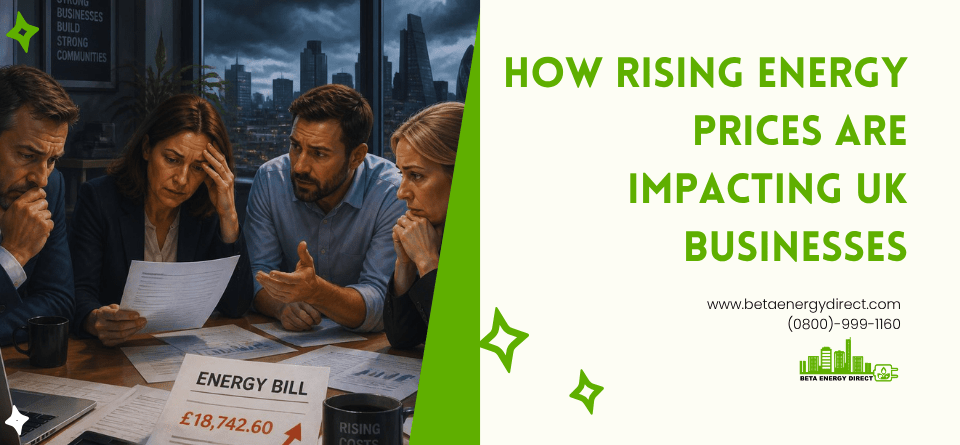
How Rising Energy Prices Are Impacting UK Businesses | A complete guide for UK SMEs
Energy has quietly become one of the biggest threats to UK business stability in 2026. According to the Office for National Statistics, 62% of UK businesses reported at least some level of concern about energy prices in late May 2026, rising to 73% among businesses with 10 or more employees. Separately, the British Chambers of Commerce found that 27% of businesses are currently struggling to pay their energy bills outright, and 52% say utility costs are directly pushing them to raise their own prices.
This is not a short-term blip. It is a structural shift in the cost of doing business in the UK, and it is reshaping hiring decisions, investment plans, and pricing strategy across almost every sector. This article breaks down exactly how rising energy prices are affecting UK SMEs in 2026, which sectors are hit hardest, and what practical steps businesses can take to protect their margins.
Why Energy Prices Are Rising for UK Businesses in 2026
Unlike household energy bills, which are protected by Ofgem’s domestic price cap, business energy pricing is entirely contract-based, with no equivalent cap limiting what suppliers can charge. That leaves commercial customers fully exposed to several compounding pressures this year.
1. Wholesale Volatility Driven by Geopolitical Disruption
Wholesale electricity costs climbed from around £75/MWh earlier in 2026 to between £94 and £116/MWh by July, while gas wholesale costs spiked to roughly 140p/therm — close to double their January 2026 level — following disruption to shipping routes linked to conflict in the Middle East. While still well below the crisis peak of over £300/MWh seen in 2022, this volatility makes budgeting genuinely difficult for businesses with little financial buffer.
2. Rising Network and Non-Commodity Costs
Even where wholesale prices stabilise, non-commodity costs are climbing sharply. TNUoS (Transmission Network Use of System) charges have risen more than 60% in 2026 under Ofgem’s new RIIO-ET3 price control, and businesses are now also absorbing a new Nuclear Regulated Asset Base (RAB) levy, introduced in November 2025 to fund new nuclear projects, which is set to rise further from January 2026. Industry analysis suggests these combined non-commodity charges could add roughly £25 per megawatt hour to business bills going forward.
3. A Longer-Term Structural Increase
This year’s pressure sits on top of a much longer trend. Average non-domestic electricity prices rose from 12.32p/kWh in Q4 2018 to 25.50p/kWh in Q4 2024 — an increase of more than 106% in six years, according to British Chambers of Commerce analysis. UK business energy bills rose a further 9.3% in the first quarter of 2026 alone.
4. Businesses Are Paying More Despite Using Less Energy
Perhaps the most frustrating trend for SMEs: many businesses have genuinely reduced their electricity consumption over the past year through efficiency measures, yet their bills continue to rise. Higher standing charges and network costs mean energy efficiency alone is no longer enough to offset rising bills — the fixed cost of simply being connected to the grid is climbing faster than usage is falling.
How Rising Energy Costs Are Actually Affecting UK Businesses
Profit Margins Are Being Squeezed Directly
For many SMEs, energy has moved from a background overhead to one of the largest single line items on the balance sheet. Manufacturing, food production, and hospitality businesses — sectors that rely heavily on continuous power for equipment, refrigeration, or heating — are feeling this most acutely, with rising costs eating directly into already thin margins.
Prices Are Being Passed on to Customers
More than half (52%) of UK businesses report facing pressure to raise their own prices because of utility costs, according to the British Chambers of Commerce’s most recent Quarterly Economic Survey. The Bank of England’s own Decision Maker Panel survey of chief financial officers found that UK firms expect to raise prices by around 4% over the coming year, with energy costs cited as a key driver — the highest reading recorded since February the previous year. This creates a knock-on effect across the wider economy, contributing to inflationary pressure well beyond the energy sector itself.
Investment and Hiring Plans Are Being Paused
Energy cost uncertainty is not just squeezing today’s margins — it is changing decisions about tomorrow. Recent industry research found that three in five mid-sized companies (60%) intend to halt or reduce investment while they wait for energy costs to stabilise, rising to around two-thirds in retail, tech, and financial services. For SMEs already operating with limited cash reserves, this often means delayed equipment purchases, paused expansion plans, and more cautious recruitment.
Some Businesses Are Struggling to Pay at All
The affordability picture is stark for a meaningful minority of UK businesses. British Chambers of Commerce data shows 27% of businesses reported difficulty paying their energy bills in early 2026, even before the most recent wholesale price escalation was fully reflected in survey responses. This is not simply a competitiveness issue for some firms — it is a genuine solvency risk.
Which Sectors Are Hit Hardest?
Energy-intensive sectors bear a disproportionate share of the impact:
- Manufacturing — high, continuous power demand for machinery and processes
- Food production and processing — refrigeration, heating, and processing equipment running around the clock
- Hospitality — heating, cooling, and cooking demands across restaurants, hotels, and pubs
- Retail — lighting, heating, and refrigeration across physical premises, often on tighter margins than other sectors
- Logistics and transport-adjacent businesses — compounding energy pressure with rising fuel and shipping costs simultaneously
Medium-sized businesses in particular are seeing some of the steepest cost increases, often falling into a gap where they are too large to access the smaller protections available to micro-businesses, yet without the purchasing power or energy management resources available to large corporates.
Why SMEs Are More Exposed Than Larger Businesses
Smaller businesses consistently face structural disadvantages when it comes to managing rising energy costs:
Limited Financial Buffers
SMEs typically hold less cash reserve relative to turnover than larger corporates, meaning a sudden increase in a major overhead like energy has a proportionally larger impact on day-to-day operations.
Weaker Negotiating Power
Large energy consumers can often negotiate more favourable terms directly with suppliers, or access bespoke flexible contracts that pass through savings during periods of lower wholesale pricing. SMEs, by contrast, are more likely to be offered standard tariffs, and are significantly more likely to end up on expensive out-of-contract or deemed rates simply through less active contract management.
Less In-House Expertise
Larger businesses often employ dedicated energy or facilities managers who track contract renewal dates, monitor market pricing, and negotiate proactively. Most SMEs do not have this resource, which is precisely why so many end up paying default rates simply because nobody was tracking the renewal date.
Regional Disparity
TNUoS and distribution network charges vary by region, and businesses located further from major generation infrastructure — including the South West, South Wales, and parts of South East England — face materially higher network charges than businesses in other parts of the country, regardless of their actual energy usage.
What UK SMEs Can Do to Protect Their Margins
The good news is that a meaningful portion of the pressure businesses are feeling is within their control, even if wholesale prices themselves are not.
1. Check Whether You Are on a Competitive Contract
If your business energy contract has expired, you are very likely paying an out-of-contract rate that can run 30% to 70% higher than a properly negotiated fixed deal. This is often the single fastest way to reduce costs without changing anything about how your business actually operates.
2. Compare the Market Regularly, Not Just at Renewal
With the spread between the cheapest and most expensive quote on an identical meter currently running at 30–50%, a periodic market comparison — even outside your renewal window — can reveal savings most business owners assume are not available.
3. Consider Longer, Fixed-Term Contracts for Budget Certainty
With wholesale forwards broadly flat through 2027–28, 24- to 36-month fixed contracts are currently pricing close to, or even below, 12-month deals, offering a rare opportunity to lock in budget certainty without paying a premium for it.
4. Review Your Standing Charges and Capacity Band
Because so much of the 2026 increase is landing on fixed standing charges rather than usage-based rates, reviewing your contracted capacity — particularly if your business has downsized or become more efficient — can uncover savings that efficiency measures alone will not.
5. Separate Gas and Electricity Comparisons
Bundled dual-fuel deals are rarely the cheapest option for business customers. Comparing business gas and business electricity independently typically produces a better combined outcome than accepting a single supplier’s bundled offer.
6. Get Independent, Professional Support
Given how much variation exists between suppliers, contract types, and regional charges, manually comparing the market accurately is genuinely difficult without dedicated tools and market access. This is exactly the gap a specialist energy broker is built to close.
How Beta Energy Direct Helps UK SMEs Navigate Rising Energy Costs
At Beta Energy Direct, based in Manchester and working with SMEs and corporates across the UK, we see first-hand how much of the pressure businesses feel from rising energy prices can be reduced through better contract management alone. While wholesale and network costs are outside any individual business’s control, the rate you actually pay is not — and the gap between a well-negotiated contract and a default rate has rarely been wider than it is in 2026.
Our approach gives your business:
- Effortless comparison of live tariffs across the whole business energy market
- Dedicated, qualified staff who explain your options clearly, without jargon
- Best prices guaranteed on the deals we recommend
- Less paperwork and faster approvals, so switching does not become another drain on your time
If rising energy costs are putting pressure on your margins, get a free business energy quote and let us check whether your business is paying more than it needs to.
Look Beyond Energy: A Wider Utilities Review Can Multiply Your Savings
Energy is rarely the only overhead under pressure. Many SMEs reviewing their energy contracts in 2026 are also finding savings by comparing their business water supply, broadband and telecom arrangements, and business finance options at the same time. In a year where every overhead is under scrutiny, a full utilities audit is one of the most effective ways to protect your bottom line.
Frequently Asked Questions
Why are energy prices rising for UK businesses in 2026?
Business energy prices are rising due to a combination of wholesale market volatility linked to geopolitical disruption, sharply increased network charges (including a 60%+ rise in TNUoS charges), a new nuclear levy, and longer-term structural cost increases that have pushed non-domestic electricity prices up by more than 106% since 2018.
How many UK businesses are affected by rising energy costs?
According to the Office for National Statistics, 62% of UK businesses reported concern about energy prices in May 2026, rising to 73% among businesses with 10 or more employees. Separately, 27% of businesses report difficulty paying their energy bills.
Which industries are hit hardest by rising energy prices?
Energy-intensive sectors including manufacturing, food production, hospitality, and retail are typically the most affected, due to their reliance on continuous power for equipment, heating, cooling, or refrigeration.
Are business energy prices protected by a price cap like household bills?
No. The Ofgem price cap applies only to domestic customers. Business energy pricing is contract-based, with no equivalent cap limiting the rates suppliers can charge, which is why proactive contract comparison matters so much more for SMEs.
Will UK business energy prices come down soon?
Forecasts remain uncertain. While some elements, such as wholesale electricity costs, have shown periods of stabilisation, rising network charges are expected to continue increasing by more than 10% annually through 2031, meaning non-commodity costs are likely to keep pushing bills upward regardless of wholesale trends.
How can my business reduce the impact of rising energy costs?
The most effective steps are checking whether you are on an out-of-contract rate, comparing the market regularly rather than only at renewal, considering longer fixed-term contracts while pricing remains favourable, and reviewing your standing charges and capacity band. Request a free quote to see where your business stands today.
Protect Your Business From Rising Energy Costs Before They Escalate Further
Rising energy prices are reshaping decisions across UK businesses in 2026, from pricing strategy to hiring and investment. While the broader market pressures are largely outside any single business’s control, the rate your business actually pays is not — and for many SMEs, a proper market comparison remains the single fastest way to protect margins this year.
Call Beta Energy Direct on (0800) 999-1160 or request your free energy comparison today, and let our team help your business energy costs work for you, not against you.